Mine Warfare Command
Crest
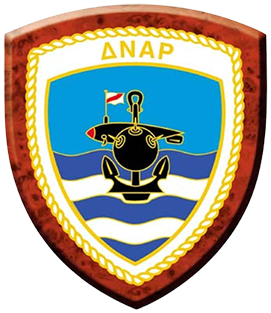
Anchor, mine and minesweeper float complex, which is half-sunk at sea. The theme of the presentation is directly related to the Command’s mission.
History
The Mine Warfare Command was established in 1980. Prior to World War II, the agency dealing with Mine Warfare was the Torpedo / Mines Command (TMC). The first Mine Warfare Command was the MAMN (Magnetic Acoustic Mine Neutralization) established in 1941 in Alexandria. In 1943, it was renamed as HAAS (Higher Administration of Anti-mine Service) and had a total of twenty-three (23) minesweepers and thirty-nine (39) observation posts. With the return of the fleet to Greece in 1944, HAAS settled in Skaramangas area and counted approximately fifty (50) ships. In 1953 HAAS was transferred to Salamis Naval Base, now falling under the Fleet Command as Minesweeping Command and in 1980 was renamed as Mine Warfare Command, with three (3) squadrons of Minesweepers and one (1) group of minesweeping boats.
Mission
The mission of the Hellenic Mine Warfare Command is to act within the scope of the orders and directions of the CINC Fleet, for the organization, administration, operational training, maintenance and generally for the readiness and preparation for war of the ships, in order to contribute to the accomplishment of the mission or the tasks assigned to the CINC Fleet, as well as maintaining readiness of assuming operational tasks at sea with mainly scope to take over Anti Mine Warfare Operations.
Operations
The Operations arising from and undertaken by the Mine Warfare Command are:
- Planning and conduct of Naval Mine Warfare (NMW) operations.
- Presence in the Aegean Sea, Ionian Sea, Mediterranean Sea, and wherever else required.
- Participation in multinational exercises, operations, missions, and Standing Naval Forces (SNF), in the framework of enforcing United Nations resolutions and maintaining international peace.
- Participation in the Multinational Maritime Headquarters GRMARFOR HQ.
- Control and protection of Critical Undersea Infrastructures (CUI) and ports.
- Control and safety of navigation through classified navigational information, including AWNIS (Allied Worldwide Navigational Warnings), and procedures/guidance under NCAGS (Naval Cooperation and Guidance for Shipping).
- Contribution to the clearance/demilitarization and disposal of historical mines through vessels and Explosive Ordnance Disposal (EOD) / Mine Clearance Diving Teams.
- Maintenance and enhancement of operational training and readiness levels of ships and personnel through national and NATO exercises.
- Review and development of technical and tactical instructions in accordance with NATO standards.
- Conduct of studies and participation in NATO and European Union committees and conferences for the development of innovative Mine Warfare solutions.
Organization
Operationally, the vessels of the Mine Warfare Command are placed under the direct authority of the Commander Mine Warfare. The duties of the Officer in Tactical Command (OTC) are carried out by the Command’s Chief of Staff when the Commander is not embarked on a Mine Countermeasures (MCM) unit.
Finally, the Mine Warfare Command includes the Mine Warfare School (MWS), the Mine Warfare Data Processing and Management Center (MWDC), and the Mine Clearance Diving Units / Explosive Ordnance Disposal (EOD) teams.
Mine Warfare School
The mission of the School is to provide appropriate theoretical, practical, and technical training on Naval Mine Warfare, as well as on the optimal use of modern systems and equipment fitted on board ships, in order to maintain and enhance their operational capability and effectiveness.
The School is equipped with one (1) classroom featuring advanced technical training equipment to ensure the effective delivery of instruction. It also operates an ROV (Remotely Operated Vehicle) simulator, PLUTO PLUS.
The instructional staff consists of suitably qualified and specialized personnel, with relevant training acquired through Hellenic Navy and NATO courses.
Mine Warfare Data Center (MWDC)
The mission of the Center is the collection and recording of environmental data and Mine Warfare–related information from Mine Countermeasures (MCM) units, and the subsequent redistribution of this information to those units and the Hellenic Navy Hydrographic Service (HNHS), for each respective area of interest. The data is utilized in support of operational tasks, including the production of classified charts and the provision of updates to the Mine Warfare Charts by the Hellenic Navy Hydrographic Service (HNHS).
Explosive Ordnance Disposal (EOD) teams
The mission of the teams is the collection of underwater environmental data, the identification and classification of underwater contacts, and the clearance/demilitarization and disposal of mines. The personnel manning these teams are trained and sustained by Hellenic Navy Special Forces Command.
Command's ships
The Mine Warfare Command comprises two (2) vessels: one (1) OSPREY-class Minehunter and one (1) HUNT-class Minehunter (with mine sweeping capability).
Our Fleet